
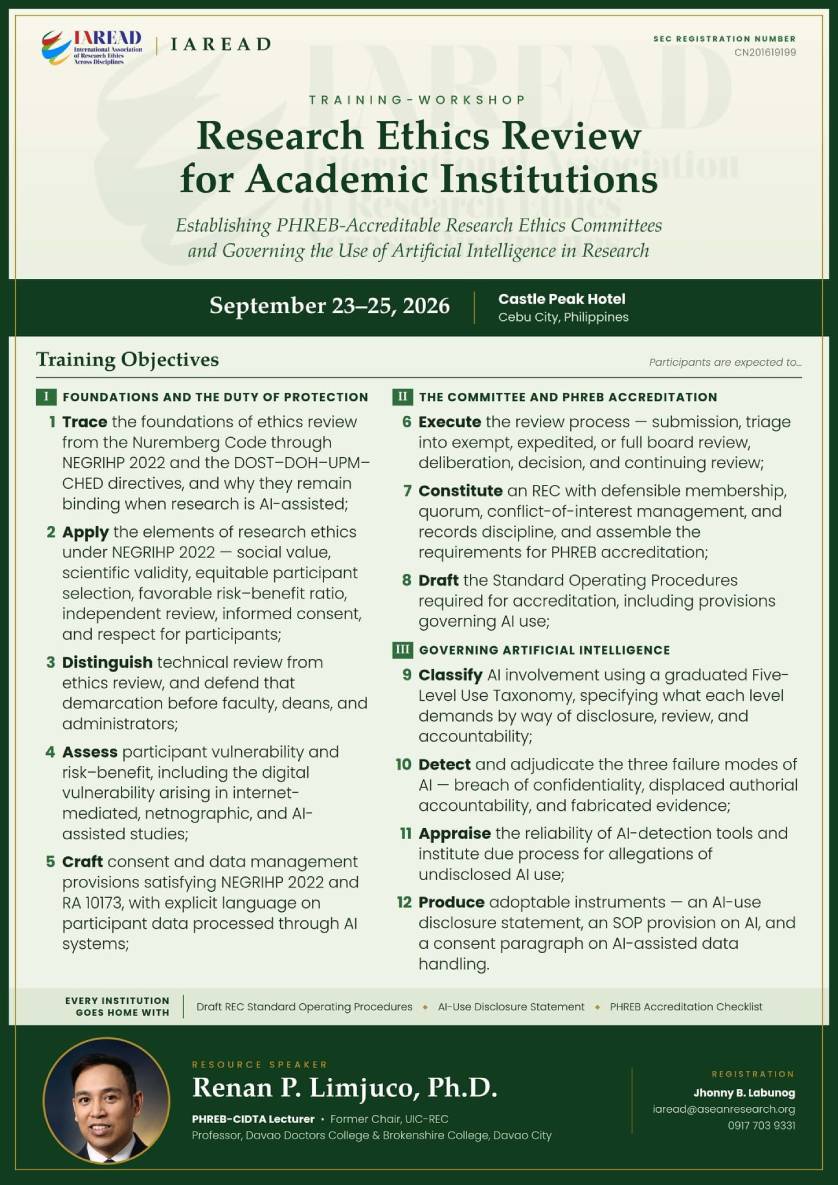
Research Ethics Review for Academic Institutions: Establishing PHREB-Accreditable Research Ethics Committees and Governing the Use of Artificial Intelligence in Research
September 23–25, 2026
Castle Peak Hotel, Cebu City, Philippines
The Philippine Health Research Ethics Board (PHREB) mandates that research ethics committees in higher education institutions be registered and accredited to ensure ethical compliance for funding and publication. This training-workshop enables institutions to build a functioning, PHREB-compliant committee that cultivates a deep culture of ethical judgment. Grounded in national guidelines, the program uniquely integrates artificial intelligence (AI) issues across the entire research ethics review lifecycle. Participants will gain a practical, defensible framework for handling AI and leave with completed, actionable policy instruments.
This training-workshop responds to that requirement on both fronts. It equips participants to constitute, operate, and document a research ethics committee that will withstand PHREB accreditation review at the level appropriate to their institution, and it develops the substantive competence in ethical reasoning that makes such a committee worth accrediting. The training is grounded in the National Ethical Guidelines for Research Involving Human Participants (NEGRIHP) 2022, the joint DOST–DOH–UPM–CHED directives, and Republic Act No. 10173, the Data Privacy Act of 2012.
A distinguishing feature of this iteration is its treatment of artificial intelligence. AI is not confined here to a concluding lecture; it is carried as a live thread through the ethics review lifecycle, because that is where Philippine committees are already encountering it — in manuscripts with fabricated citations, in transcripts uploaded to commercial chatbots, in accusations of undisclosed AI use levelled at students without a shred of due process. Institutional and journal policies on AI will continue to change faster than any training material can be revised. The training therefore aims to leave participants not with a memorized rulebook but with a defensible framework of judgment: a graduated taxonomy for classifying AI involvement in research, a working grasp of the three ways AI reliably corrupts the research record, and drafted policy instruments they can bring home and adopt.
Sessions are paired with structured workshops so that participants leave with completed outputs rather than notes on outputs they intend to produce.
The International Association of Research Ethics Across Disciplines, Inc. (IAREAD), with SEC Registration Number CN201919199, is cordially inviting you to participate in the training workshop on Research Ethics Review for Academic Institutions: Establishing PHREB-Accreditable Research Ethics Committees and Governing the Use of Artificial Intelligence in Research on September 23–25, 2026, at the Castle Peak Hotel, Cebu City, Philippines. The program will be conducted and facilitated by Dr. Renan Limjuco, PHREB-CIDTA Research Ethics Trainer.
Intended Participants
Prospective and incumbent members of institutional research ethics committees; research directors, deans, and graduate program coordinators; institutional research office staff; journal editors and peer reviewers; and faculty researchers and thesis advisers across disciplines. No prior training in research ethics is presumed.
Terminal Learning Outcome
At the close of the training, participants shall be able to constitute, operate, and document a research ethics committee that meets PHREB accreditation standards, and to review — with defensible reasoning — protocols and manuscripts in which artificial intelligence has been used as a research instrument.
The training objectives are to:
- Trace the historical and normative foundations of research ethics review from the Nuremberg Code through NEGRIHP 2022 and the DOST–DOH–UPM–CHED directives, and articulate why those foundations remain binding when research is AI-assisted;
- Apply the elements of research ethics under NEGRIHP 2022 — social value, scientific validity, equitable participant selection, favorable risk–benefit ratio, independent review, informed consent, and respect for participants — to protocols drawn from across the disciplines;
- Distinguish technical review from ethics review in scope, composition, and accountability, and defend that demarcation before faculty, deans, and administrators;
- Assess participant vulnerability and conduct risk–benefit analysis, including the forms of digital and informational vulnerability that arise in internet-mediated, netnographic, and AI-assisted studies;
- Craft informed consent and data management provisions that satisfy both NEGRIHP 2022 and RA 10173, with explicit language governing the processing of participant data through third-party AI systems;
- Execute the research ethics review process — submission, triage into exempt, expedited, or full board review, deliberation, decision, and continuing review — using standard committee documentation;
- Constitute a research ethics committee with defensible membership, quorum rules, conflict-of-interest management, and records discipline, and assemble the documentary requirements for PHREB accreditation at the level appropriate to the institution;
- Draft the Standard Operating Procedures required for accreditation, including provisions governing the use of AI by researchers and by the committee itself;
- Classify the involvement of AI in a given study using a graduated use taxonomy, and specify what each level demands by way of disclosure, review, and researcher accountability;
- Detect and adjudicate the three recurring failure modes of AI in research — breach of confidentiality, displacement of authorial accountability, and fabrication of evidence — as they appear in submitted protocols and manuscripts;
- Appraise the reliability of AI-detection tools and institute a due-process procedure for allegations of undisclosed AI use that protects research integrity and the rights of the accused alike; and
- Produce institution-specific policy instruments ready for adoption: an AI-use disclosure statement, an SOP provision on artificial intelligence, and a consent paragraph on AI-assisted data handling.
Training Programme
Day 0 — Arrival of Participants and Pre-Registration
Arrival of participants. Pre-registration, distribution of training kits, and submission of each institution’s existing REC documents (if any) for use in the workshops.
Day 1 — Foundations of Ethics Review and the Duty of Protection
7:00am – 8:20am: Registration
8:20am – 8:45am: Opening Program. Prayer, National Anthem, introduction of the resource speaker. Baseline Diagnostic: anonymous poll on participants’ own current use of AI in research and review — results are carried forward into Day 2 (Plenary / Poll)
8:45am – 9:45am: Session 1. Why Ethics Review Exists. From Nuremberg and Tuskegee to the Declaration of Helsinki, CIOMS, NEGRIHP 2022, and the DOST–DOH–UPM–CHED directives — and why every one of these obligations survives the arrival of AI (Lecture-Discussion)
9:45am – 10:00am: Morning Break — Intermission number from the resource speaker
10:00am – 10:45am: Session 2. Good Research Practice and Research Integrity. Fabrication, falsification, plagiarism, and the questionable practices that fall short of misconduct but corrode the record (Lecture-Discussion)
10:45am – 11:45am: Session 3. The Elements of Research Ethics (NEGRIHP 2022). The seven elements worked through with cross-disciplinary protocol excerpts — health, education, social science, and engineering (Lecture-Discussion)
11:45am – 12:00nn: Session 4. Technical Review Is Not Ethics Review. Scope, membership, and accountability of each; briefing for Workshop 1 (Lecture / Briefing)
12:00nn – 1:00pm: Lunch Break
1:00pm – 1:50pm: Session 5. Ethical Issues Across Study Designs. Observational versus interventional research; social science and public health research; and the newer terrain of internet-mediated, netnographic, and AI-mediated studies where the participant may never know a researcher was present (Lecture-Discussion)
1:50pm – 2:35pm: Session 6. Vulnerability and Risk–Benefit Assessment. Classical vulnerable populations, the vulnerability created by institutional hierarchy in campus research, and digital and informational vulnerability. Includes a compressed treatment of the special obligations attaching to clinical and interventional trials (Lecture-Discussion)
2:35pm – 3:25pm: Session 7. Informed Consent, Confidentiality, and the Data Privacy Act. Elements of valid consent; assent and proxy consent; waiver conditions. RA 10173 obligations, and the consent language now required when participant data will pass through a third-party AI system (Lecture-Discussion)
3:25pm – 3:40pm: Afternoon Break
3:40pm – 4:40pm: Workshop 1. Demarcation and Triage. Part A: build the demarcation grid separating technical from ethics review. Part B: triage six real protocol abstracts into exempt, expedited, or full board review and justify each ruling to the plenary (Group Workshop)
4:40pm – 5:00pm: Session 8. Ethical Issues in Research Publication. Authorship criteria, gift and ghost authorship, redundant publication, predatory journals — and the first look at AI-generated text in the manuscript. Bridge to Day 2 (Lecture-Discussion)
Day 2 — The Committee in Operation and the Question of Artificial Intelligence
8:00am – 8:30am: Registration and Recap of Day 1. Participant-led synthesis; unresolved questions posted for the day (Plenary)
8:30am – 9:15am: Session 9. The Research Ethics Review Process (NEGRIHP 2022). Submission, triage, deliberation, decision, communication of the decision, continuing review, and closure — walked through with the actual forms (Lecture-Discussion)
9:15am – 10:00am: Session 10. Constituting and Operating the REC. Membership and the non-affiliated member; quorum; conflict of interest; independence from administration; minutes and records discipline; the archive PHREB will ask to see (Lecture-Discussion)
10:00am – 10:15am: Morning Break
10:15am – 11:00am: Session 11. PHREB Registration and Accreditation. Levels of accreditation and which one your institution should seek; the documentary requirements one by one; the deficiencies that most often send an application back; timelines and renewal (Lecture-Discussion)
11:00am – 11:30am: Session 12. Principles of Standard Operating Procedures. What an SOP must specify, the anatomy of an SOP set, version control, and the common drafting failures. Briefing for Workshop 2 (Lecture / Briefing)
11:30am – 1:00pm: Workshop 2. SOP Drafting Sprint. Institutional teams draft the core SOPs of their committee. Working lunch from 12:00nn; facilitator circulates for consultation (Institutional Teams)
12:00nn – 1:00pm: Working Lunch — Workshop 2 continues
1:00pm – 1:50pm: Session 13. Artificial Intelligence in Research: Capability and Failure. What these systems actually do and what they cannot do. Live demonstration: the resource speaker prompts a model before the room and it fabricates a plausible Philippine journal citation. Introduction of the Five-Level AI Use Taxonomy (Level 0, no AI, through Level 4, AI-generated content) as the shared vocabulary for the rest of the day (Lecture / Live Demo)
1:50pm – 2:40pm: Session 14. The Three Hard Problems. (a) Confidentiality — what actually happens to an unpublished protocol or an interview transcript uploaded to a commercial chatbot, and the RA 10173 exposure it creates for the institution. (b) Accountability — why ICMJE, COPE, and WAME converge on the position that an AI cannot be an author. (c) Fabrication — invented citations, synthesized data, and manipulated images (Lecture-Discussion)
2:40pm – 2:55pm: Afternoon Break
2:55pm – 3:40pm: Session 15. AI in Qualitative Inquiry, and the Problem of Detection. Where AI legitimately assists thematic analysis and netnographic work and where it quietly substitutes for the researcher’s interpretive judgment. Then: the unreliability of AI-detection tools, the documented bias against non-native English writers, and why an accusation founded on a detector score is itself an ethics violation (Lecture-Discussion)
3:40pm – 4:30pm: Workshop 3. The AI Policy Clinic. Each institutional team drafts three adoptable instruments: (i) an AI-use disclosure statement for researchers, (ii) an SOP provision governing AI use by researchers and by the committee, and (iii) an informed-consent paragraph on AI-assisted data handling. Teams then adjudicate two contested cases involving undisclosed AI use (Institutional Teams)
4:30pm – 5:00pm: Presentation of Workshop Outputs, Open Forum, and Synthesis. Institutional commitment setting, return to the Day 1 baseline diagnostic, and awarding of certificates by institution (Plenary)
Note: Sessions are deliberately paired with workshops so that participants leave holding completed documents rather than intentions. Time allocations may be adjusted by the resource speaker in response to the composition and pace of the group.
Expected Workshop Outputs
Every participating institution should depart with the following in hand:
- Demarcation grid separating technical review from ethics review, ready for presentation to the research office and academic council;
- Triage decision log documenting the reasoning behind exempt, expedited, and full board classifications;
- Draft Standard Operating Procedures covering the core functions of the committee;
- AI-use disclosure statement for adoption in theses, dissertations, and faculty submissions;
- SOP provision on artificial intelligence governing use by researchers and by the committee itself;
- Informed-consent paragraph addressing AI-assisted processing of participant data; and
- Accreditation documentary checklist annotated to the institution’s current state of readiness.
Notes on the Design of this Iteration
Three deliberate departures from the conventional research ethics training matrix are worth stating plainly for institutions comparing programs.
- AI is distributed rather than appended. Confining artificial intelligence to a closing lecture teaches participants that it is a separate topic. It is not. It appears in consent, in confidentiality, in authorship, in the review process itself, and it is placed at each of those points.
- The accreditation session is given the weight it warrants. Institutions come to this training because PHREB requires registration and accreditation. That session is therefore expanded and treated in operational detail, including the deficiencies that most commonly return an application.
- Detection is treated as an ethics problem, not a solution. AI-detection software is unreliable enough, and biased enough against writers for whom English is a second language, that its uncritical use in Philippine institutions is producing a new category of injustice. Committees are prepared to institute due process instead.
What Participants Should Prepare
- A laptop with charger and the capacity to connect to the internet when required;
- Existing institutional documents — any current REC charter, SOPs, consent templates, or research manual, in editable form, since the workshops build directly on them;
- One anonymized protocol from the institution, for use in the triage and review exercises; and
- The authority to draft. Institutions are urged to send members who can actually commit the committee to the documents produced here.
Resource Speaker
RENAN P. LIMJUCO, PhD
PHREB-CIDTA Research Ethics Trainer
Professor, Davao Doctors College and Brokenshire College, Davao City
Confirmation and Contact Details
For interested participants, please register via Google Form at https://docs.google.com/forms/d/e/1FAIpQLSeiCOmDPtM3fijeIlWc2bjnB43IfdE4vcZbPh61jef8lT_iHQ/viewform. The deadline for the submission of the confirmation will be on September 19, 2026 (Saturday). For more details, please contact us at this mobile number +63917-703-9331.
Training Fee:
7,000.00 Php, includes an Active Membership Certificate, Training Certificate (Certificate of Research Engagement, Certificate of Completion, and Certificate of Attendance), Training Kit, ID, Lunch and Snacks.
Invitation to Attend this Training and Volunteer Opportunity:
If you wish to ask for a Personal Invitation, please send us a message with the name of the recipient and provide an active email address.
Also, if you are willing to be a volunteer and be part of the Organizing Committee, please let us know by writing us at [email protected].
Payment Details
Payment through Bank:
Name of Bank: Bank of the Philippine Islands (BPI)
Address: George Town, Kauswagan, Cagayan de Oro
Account Name: International Association of Research Ethics Across Disciplines, Inc.
Account Number: 8991-0004-54
Payment through Western Union, M Lhuillier, Palawan, or Cebuana Lhuillier:
Name of Recipient: Jhonny B. Labunog (09177039331)
Address: Door 204 Second Floor CONEX Bldg., Rizal-Gaerlan Street, Barangay 2, Cagayan de Oro City 9000, Philippines
GCash
In your GCash Application, please select Bank Transfer, click BPI, then input the following:
Amount: 7,000.00
Account Name: IAREAD, Inc.
Account Number: 8991000454
Email Address: [email protected]
Then click the Send Button. We kindly request that you inform us and submit the transaction slip.
All check payments should be made to the International Association of Research Ethics Across Disciplines, Inc.
Contact Details
Mr. Jhonny B. Labunog
Training Specialist
International Association of Research Ethics Across Disciplines, Inc. (IAREAD)
Mobile and Viber +63 917 703 9331
2F Door 4, Montblanc Building, Cagayan de Oro City 9000
(+6388) 323-4282
[email protected]
http://aseanresearch.org/iaread